Walk into any modern factory and you will see light covers, machine guards, display shields, and protective panels made from clear plastic. Most of them are not glass. They are Polycarbonate transparent profiles.
I have worked with extrusion teams, façade contractors, and refrigeration manufacturers for years. One thing is clear. When the profile is designed correctly, polycarbonate performs brilliantly. When it is selected without proper planning, it causes stress cracks, yellowing, or fitting issues within months.
If you are planning to use custom polycarbonate transparent profile manufacturing for your next project, this guide will help you avoid common mistakes and make better decisions.
What Are Polycarbonate Transparent Profiles?
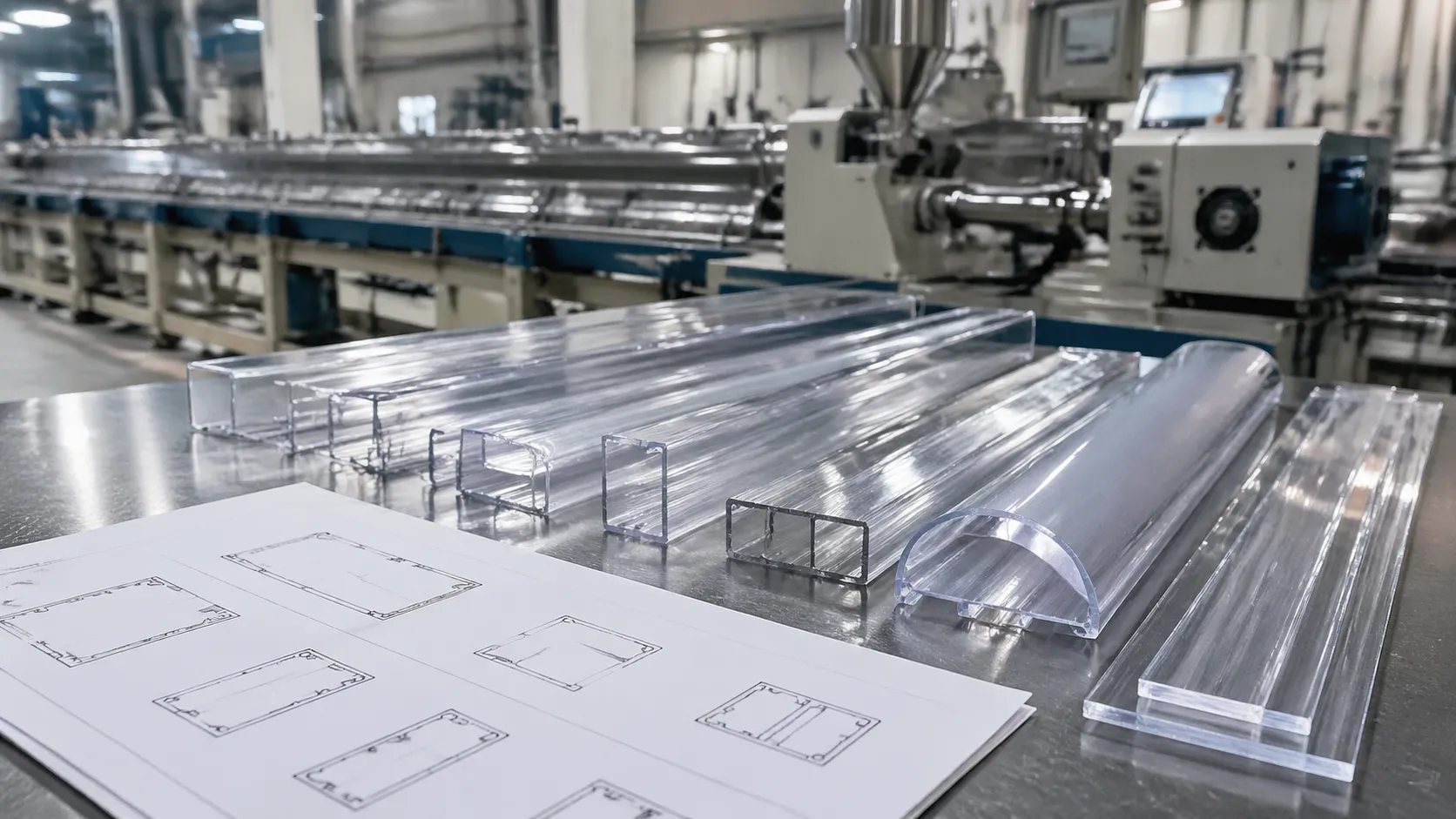
Polycarbonate transparent profiles are extruded plastic sections made from polycarbonate resin. They are shaped through a die to create specific cross sections such as U channels, H connectors, flat strips, diffusers, or custom technical shapes.
They are widely used in:
- Commercial refrigerator doors
- Machine safety guards
- LED light diffusers
- Industrial enclosures
- Protective glazing systems
They are chosen because they offer:
- High impact resistance
- Optical clarity
- Heat resistance
- Good dimensional stability
But not every project suits them equally. Let’s go step by step.
1. Understand Why You Need Polycarbonate, Not Acrylic
This is the first confusion I see on shop floors.
Both materials look similar. Both are clear. But performance is very different.
Polycarbonate:
- Very high impact resistance
- Better for industrial safety parts
- More flexible under load
Acrylic:
- Higher surface hardness
- Better scratch resistance
- More brittle under impact
If your application involves mechanical stress, vibration, or handling during assembly, polycarbonate transparent profiles are usually the safer option.
For static decorative use, acrylic may be enough. But for industrial use, I rarely recommend taking that risk.
2. Check the Exact Temperature Range
Polycarbonate performs well in moderate heat, but every project has limits.
Typical properties:
- Continuous use temperature: around 110–120°C
- Good low-temperature impact resistance
If your profile will sit near compressors, LED heat sinks, or processing equipment, confirm actual working temperature.
I have seen profiles installed near heat sources without proper testing. Within months, warping starts. Always ask your polycarbonate profile manufacturer for temperature test data.
3. UV Exposure Matters More Than You Think
Outdoor applications require UV-stabilised material.
Without UV protection:
- Yellowing may occur
- Surface brittleness can increase
- Optical clarity reduces over time
Many façade and skylight applications fail because buyers assume standard resin is enough.
If used outdoors, clearly specify:
- UV stabilised grade
- Co-extruded UV layer if required
A reliable transparent plastic extrusion supplier will guide you here, but you must ask the question first.
4. Design the Profile Around Real Installation Conditions
In theory, drawings look perfect. On site, conditions are different.
Consider:
- Expansion and contraction
- Screw fixing pressure
- Frame tolerance
- Load distribution
Polycarbonate expands more than metal. If you lock it tightly inside aluminium frames without expansion allowance, stress marks appear.
A good custom profile extrusion manufacturer will review your technical drawing and suggest small but important adjustments.
This is where technical drawing-based extrusion becomes critical. Share exact CAD files, expected loads, and installation method.
5. Thickness and Wall Design Affect Performance
Many failures are not material issues. They are design issues.
Too thin:
- Flexing
- Distortion
- Reduced lifespan
Too thick:
- Unnecessary cost
- Longer cooling time
- Possible internal stress
From my experience, balanced wall thickness gives better long-term stability. Always request prototype samples before bulk production.
If you are working with an industrial plastic extrusion company, insist on sample approval under real working conditions.
6. Optical Clarity Is Not Just About Transparency
Clear does not always mean high quality.
You should check:
- Light transmission percentage
- Internal bubbles
- Flow lines
- Surface finish
For LED diffusers, even slight internal lines affect light distribution.
Many manufacturers now choose polycarbonate transparent profiles for clarity and strength in demanding industrial applications. But clarity depends heavily on processing control.
Ask your bulk plastic profile supplier about:
- Extrusion temperature control
- Die polishing quality
- Cooling method
Good extrusion control makes visible difference.
7. Fire Rating and Safety Compliance
Industrial buyers often forget this until late.
Polycarbonate grades vary in the following:
- Flame retardancy
- Smoke emission levels
- Compliance with UL or similar standards
If your product goes into electrical housings or commercial refrigeration units, check regulatory requirements early.
A responsible plastic extrusion company for industrial use will provide material certification documents.
Do not wait until the final inspection stage.
8. Tolerances and Repeat Production Capability
In industrial manufacturing, repeat consistency is everything.
If you supply to:
- Refrigerator OEMs
- LED housing manufacturers
- Glass processors
They expect an exact fit every time.
Check:
- Dimensional tolerance range
- Batch consistency
- Quality control process
A reliable partner for custom polycarbonate extrusion should maintain stable die settings and calibrated equipment.
In my opinion, consistency is more important than price. A slightly cheaper profile that varies in size will cost far more in production downtime.
9. Consider Chemical Exposure
Polycarbonate resists many impacts, but certain chemicals can cause stress cracking.
Be cautious with:
- Strong solvents
- Cleaning agents
- Oils under pressure
If your application includes chemical exposure, request compatibility data from your polycarbonate profile manufacturer.
I have seen transparent guards fail simply because cleaning teams used aggressive solvent sprays.
10. Plan for Bulk Production, Not Just Sampling
Many buyers focus on sample quality but ignore scaling issues.
Ask these questions before approving:
- What is the monthly production capacity?
- How is raw material sourced?
- Is there batch traceability?
- Can the supplier handle repeat project orders?
Working with a stable custom profile extrusion manufacturer ensures that once your design is approved, it can be reproduced consistently for years.
For example, companies like M3 Extrusion focus on industrial supply rather than retail distribution. That production mindset makes a big difference when supplying to OEMs who require ongoing quantities instead of one-time orders.
Quick Comparison Table
| Factor | Why It Matters | What to Check |
|---|---|---|
| Material Grade | Performance & safety | UV, flame rating |
| Wall Thickness | Strength & cost | Balanced design |
| Tolerance | Fit in assembly | ± tolerance range |
| Surface Quality | Visual clarity | Flow lines, bubbles |
| Production Capacity | Long-term supply | Monthly output |
Common Mistakes I See in Real Projects
Let me be honest. These are the most frequent issues:
- Choosing material only based on cost
- Not accounting for thermal expansion
- Skipping prototype validation
- Ignoring UV stabilisation
- Over-tightening during installation
What usually works is simple:
- Early technical discussion
- Clear CAD drawings
- Real condition testing
- Long-term supplier partnership
What often fails is rushing the design stage.
Who Should Use Polycarbonate Transparent Profiles?
They are ideal for:
- Commercial refrigeration door frames
- LED lighting diffusers
- Protective machine guards
- Industrial glazing connectors
They are not ideal for:
- Applications requiring high scratch resistance without coating
- Constant exposure to aggressive solvents
Choose wisely based on use case.
Final Takeaway
If you treat transparent polycarbonate profiles like a basic plastic strip, you will face problems. If you treat them as engineered components, designed and produced with proper planning, they perform exceptionally well.
From my experience, success depends on three things:
- Correct grade selection
- Proper profile design
- Reliable bulk production capability
When those align, polycarbonate becomes one of the most dependable materials in industrial extrusion.
FAQs
1. What are polycarbonate transparent profiles mainly used for?
Polycarbonate transparent profiles are commonly used in industrial applications such as refrigerator doors, LED diffusers, safety guards, and glazing connectors. They provide high impact resistance, good clarity, and reliable performance under mechanical stress, making them suitable for long term industrial use.
2. Are polycarbonate profiles better than acrylic profiles?
Polycarbonate profiles are generally stronger and more impact resistant than acrylic. Acrylic offers better surface hardness and scratch resistance, but it is more brittle. For industrial environments where strength and durability matter, polycarbonate is often the preferred material.
3. Can polycarbonate transparent profiles be used outdoors?
Yes, they can be used outdoors if UV stabilised grades are selected. Standard grades may yellow or weaken over time under direct sunlight. Always specify UV protection when ordering profiles for façade, roofing, or external industrial installations.
4. How important are tolerances in custom extrusion?
Tolerances are critical in industrial production. Even small dimensional variations can cause assembly problems or fitting issues. A reliable extrusion partner should maintain tight control over die settings and quality checks to ensure repeat consistency in bulk orders.
5. Do polycarbonate profiles resist heat?
Polycarbonate handles moderate heat well and typically performs up to around 110–120°C in continuous use. However, it is important to confirm exact temperature conditions in your application before finalising the material grade.
6. Is custom polycarbonate extrusion suitable for bulk manufacturing?
Yes, custom polycarbonate extrusion is suitable for bulk manufacturing when the supplier has stable production systems and proper quality control. It allows consistent replication of technical drawings for ongoing industrial supply and repeat project requirements.